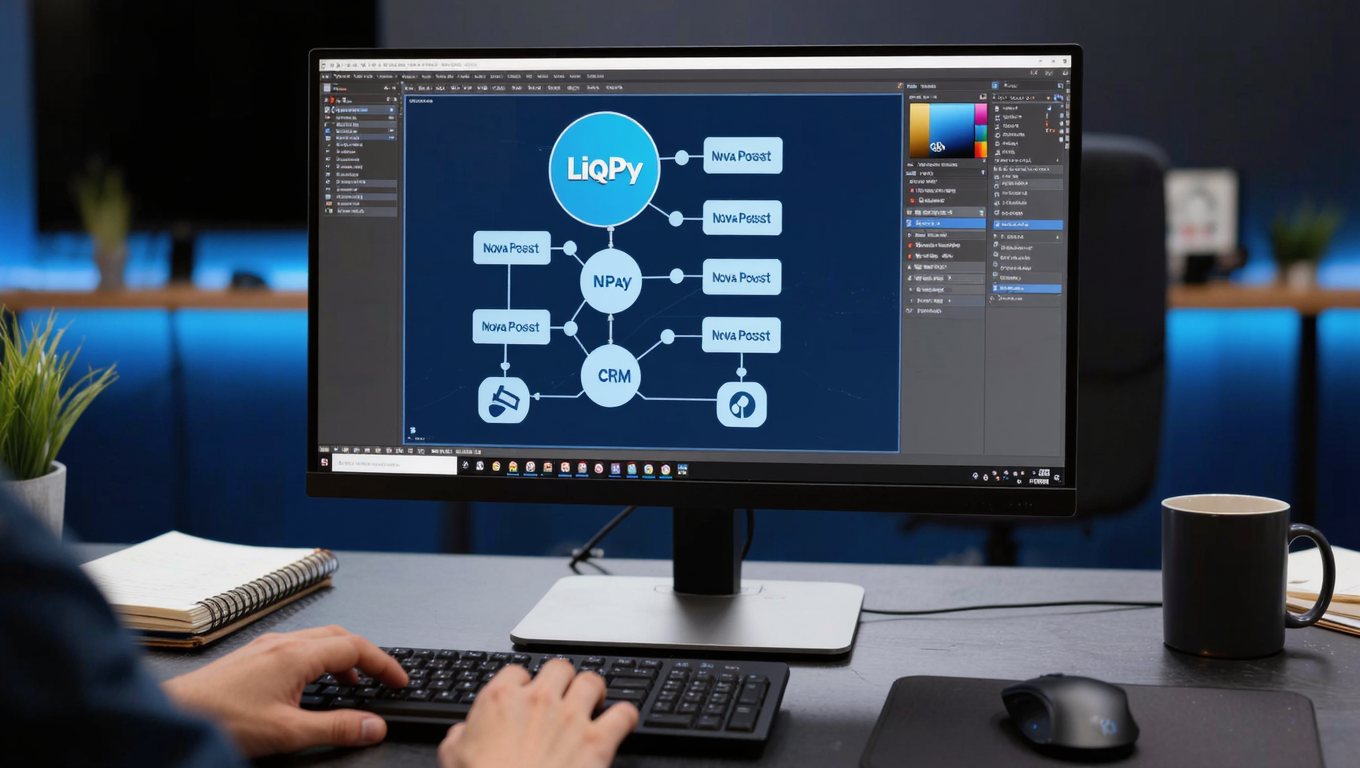
API Integrations for Ukrainian Business: Connecting Your Digital Stack
Most businesses run on more software than they realise — and most of that software does not talk to the rest. The result is data re-entered between systems, reports assembled manually, and operational decisions made on information that is hours or days out of date. API integration solves this. Done correctly, it connects your digital stack into a single source of operational truth.
Why integration matters more than individual tools
The value of a CRM is not in the CRM itself. It is in whether the CRM receives data automatically from every touchpoint — your website forms, your e-commerce platform, your payment provider, your customer service system. A CRM that requires manual data entry is not a CRM. It is a spreadsheet with a monthly subscription fee.
The same logic applies to every system in your stack. An ERP that does not sync with your e-commerce inventory creates stock discrepancies. A payment provider that does not notify your order management system requires someone to reconcile payments manually. An accounting system that cannot receive invoice data from your CRM requires a bookkeeper to re-enter it.
Integration eliminates the gaps between systems. The data flows automatically. The staff who were entering it do something more valuable instead.
Ukrainian payment integrations
Ukrainian businesses operate with payment infrastructure that most international platforms do not support out of the box. We have deep experience integrating the providers your customers actually use.
LiqPay. Ukraine's most widely used payment gateway, operated by PrivatBank. We integrate LiqPay into WordPress sites, OpenCart stores, Laravel applications, and custom checkout flows. Implementation covers payment initiation, webhook-based confirmation, refund processing, and subscription billing where applicable.
Monobank. Increasingly the preferred payment option for younger Ukrainian consumers. We integrate Monobank's acquiring API with the same scope — payment processing, webhook handlers for confirmation and failure events, and reconciliation support.
For both providers, we implement proper error handling: failed payments are logged with error codes, customers receive accurate feedback, and your operations team can identify and investigate failures without database access.
Delivery service integrations
Manual order dispatch — copying addresses into a carrier portal, printing labels, updating tracking numbers — is one of the highest-volume sources of operational overhead in Ukrainian e-commerce. We automate it.
Nova Poshta API. We integrate Nova Poshta's full API suite: branch lookup for the checkout selector, shipment creation triggered by order confirmation, label generation, tracking status polling, and delivery event webhooks that update your order management system automatically. When a parcel is delivered, your system knows within minutes.
Ukrposhta API. The same scope for Ukrposhta — branch lookup, shipment creation, tracking, and status updates. For businesses that offer both carriers, we implement a unified delivery selector that calculates rates and availability for each option in real time.
CRM and ERP integrations
The systems that manage your customer relationships and business operations need to communicate with every data source in your stack. We build integrations that make this happen reliably.
1C integration. Many Ukrainian businesses run 1C for accounting and inventory. We build REST API bridges between 1C and web platforms — synchronising product catalogs, inventory levels, order data, and customer records in both directions. The web platform reflects what is in 1C. 1C reflects what is happening on the web.
CRM webhook handlers. Every form submission, every e-commerce order, every customer service interaction can create or update a CRM record automatically. We build webhook handlers that receive events from any source, validate the data, transform it to the CRM's schema, and post it — with error handling and retry logic so that failures do not silently drop records.
Custom ERP connections. For businesses with proprietary or highly customised ERP systems, we build bespoke API integrations designed around the actual data model and business rules of the system, not a generic template.
The integration architecture we deliver
Every integration we build follows the same engineering principles:
Idempotency. Processing the same webhook event twice should not create duplicate records. We build webhook handlers that detect and discard duplicate events, preventing the data corruption that naive implementations allow.
Error handling and retry logic. External APIs fail. Network connections drop. We build integrations that retry failed requests with exponential backoff, log errors with full context, and alert your team when failures exceed expected thresholds.
Observability. Every integration ships with logging that allows your team to answer the question "what happened to this order / payment / record?" without a developer investigation. Log entries are structured, searchable, and retained for a configurable period.
Documentation. The integration is documented: what it connects, what data it moves, what it does when things go wrong, and how to test it. When your team needs to extend or modify the integration, they have a starting point.
n8n as the integration layer
For businesses that need to connect multiple systems without building custom code for each connection, we deploy n8n as a visual workflow automation layer. n8n sits between your systems, receives events, applies business logic, and routes data to the correct destination.
This approach is particularly effective when the integration requirements evolve over time — adding a new system, changing a routing rule, or adjusting data transformation logic can be done in the n8n workflow editor without a code deployment.
What an integration project looks like
We scope every integration project with a technical discovery session. We map the data flows, identify the systems involved, document the edge cases, and produce a specification before any code is written.
Most single-pair integrations — one system to one system — are delivered in two to four weeks. Multi-system integration projects are phased, with the highest-value connections delivered first.
Running systems that do not talk to each other? Start with a technical consultation. We will map your current stack, identify the highest-value integration opportunities, and scope a solution that fits your timeline and budget.