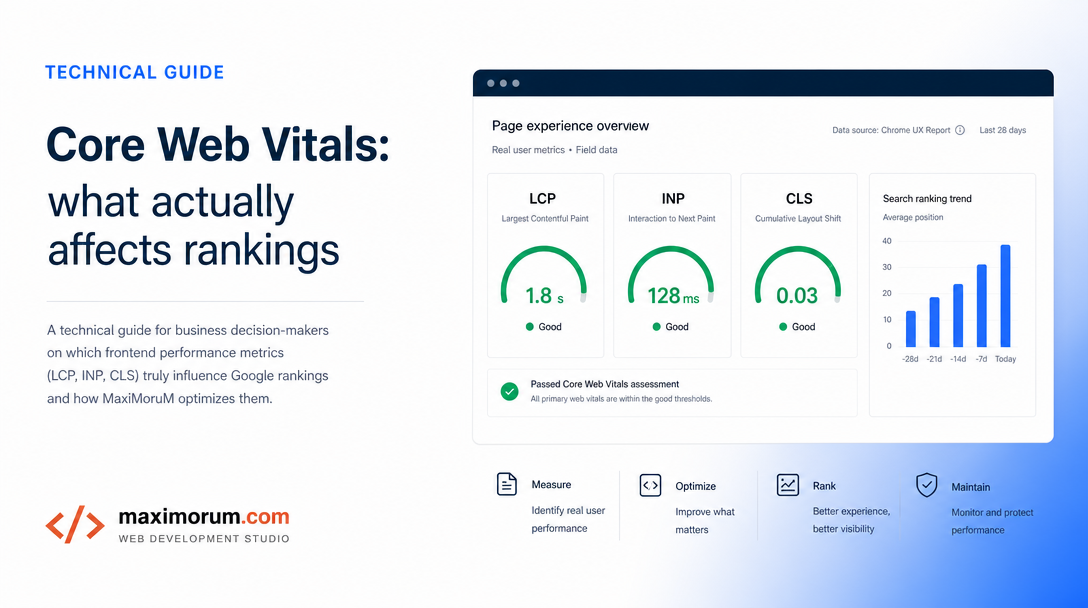
A client came to us convinced their traffic drop was a content problem. They had rewritten half their pages and hired a copywriter. The real issue sat in the browser: the product page took 4.8 seconds to render its main image, and the "Buy" button jumped down the screen just as customers tried to tap it. Google noticed. So did the customers who left.
Core Web Vitals measure that lived experience. Google confirmed they are a ranking signal, so they belong in every serious performance conversation. But they are a tie-breaker, not a magic lever — relevance and content still decide most of the ranking. The point is simple: when two pages compete, the faster, steadier one wins, and a poor score can hold back a page that deserves to rank.
Three metrics matter
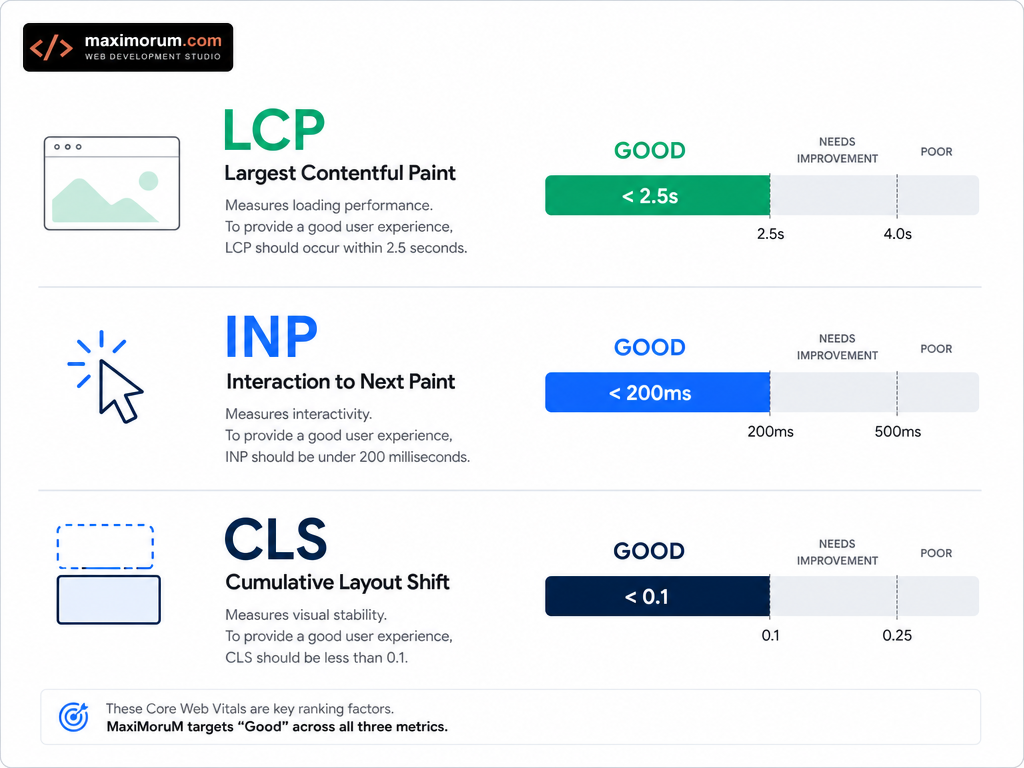
There are three numbers to watch, each tied to a "good" threshold Google publishes:
- LCP (Largest Contentful Paint) — under 2.5 seconds. How fast the main content appears. Usually a hero image, banner, or headline.
- INP (Interaction to Next Paint) — under 200 milliseconds. How quickly the page responds when someone taps or clicks. This replaced FID in 2024 and is stricter.
- CLS (Cumulative Layout Shift) — under 0.1. How much the layout jumps while loading. The cause of mis-taps and rage clicks.
What actually moves them
Most sites fail on a handful of predictable causes. We start by measuring real users through the Chrome UX Report and PageSpeed Insights, not a single lab test on a fast laptop.
For LCP, the usual culprits are oversized images and render-blocking CSS or JavaScript. We convert images to WebP or AVIF, set explicit width and height, preload the hero asset, and serve through a CDN. For INP, heavy JavaScript on the main thread is the enemy — we break up long tasks, defer third-party scripts, and cut unused code. For CLS, we reserve space for images, ads, and embeds so nothing shifts, and we load fonts without the flash that pushes text around.
The order matters. Fix the metric that fails for the most users first, deploy, then re-measure against field data. Chasing a perfect lab score while real visitors still wait is wasted effort.
What the business gets
The client above went from a 4.8-second LCP to under 2 seconds and eliminated the layout shift on the product page. Rankings recovered over the following weeks, and — more immediately — the checkout stopped losing people at the tap. Speed is not only an SEO signal. A page that responds fast converts better, on every device.
If your rankings slipped and the content is sound, the answer is often in the numbers your visitors feel but never name. We audit Core Web Vitals against real field data, fix the causes in priority order, and build the result on a stack engineered to stay fast — PHP, Laravel, WordPress, or OpenCart.
Talk to MaxiMoruM about a performance audit: https://maximorum.com/