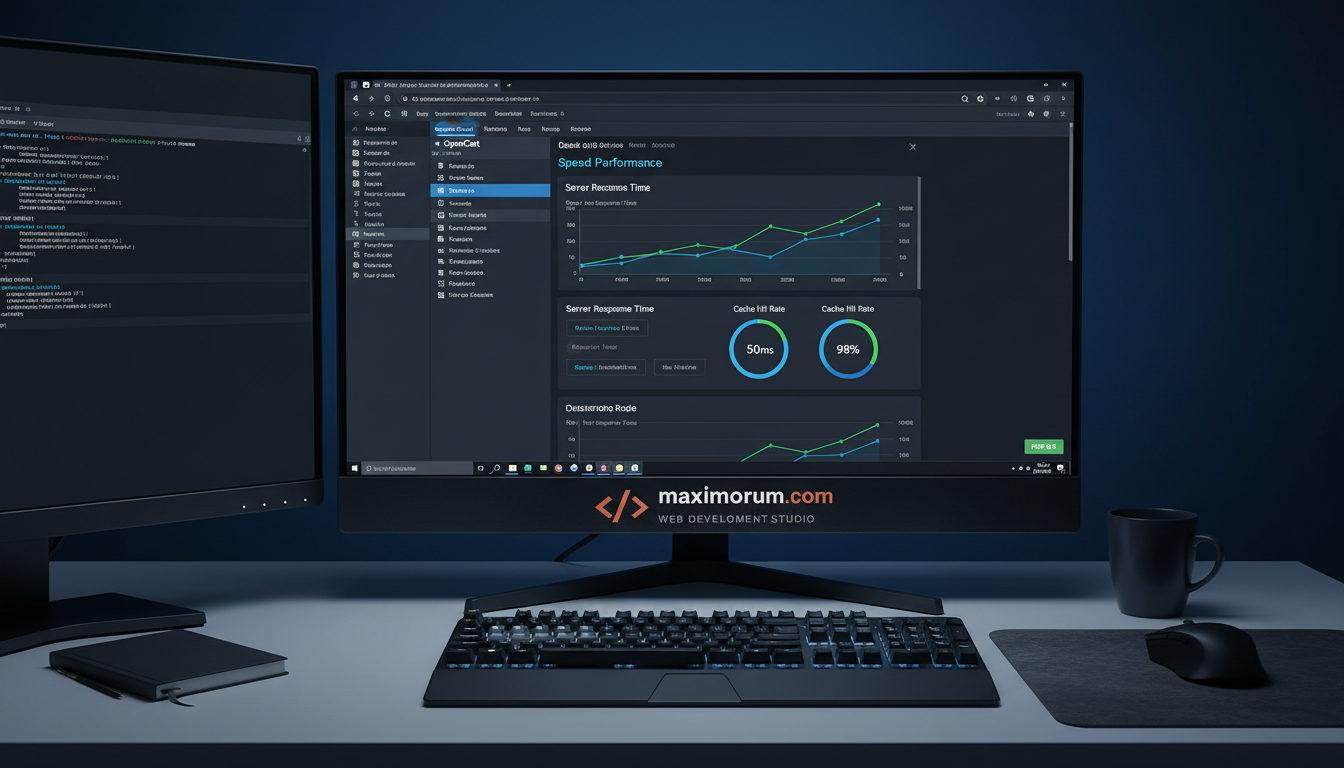
A slow online store costs sales. Research shows that a 1-second delay in page load reduces conversions by up to 7%. For OpenCart stores running on PHP 8.x and MySQL, the performance gap between a default install and a tuned one is measured in seconds — not milliseconds.
At MaxiMoruM, we've optimized OpenCart platforms for clients with catalogs ranging from 500 to 50,000 products. Here's what actually moves the needle.
Enable PHP OPcache and tune it
PHP OPcache stores compiled bytecode in memory, cutting execution time by 30–50% on repeat requests. On a production OpenCart server, set opcache.memory_consumption=256, opcache.max_accelerated_files=20000, and opcache.validate_timestamps=0. Paired with PHP 8.2, this alone can shave 400–800ms off your average page load.
Switch to a Redis-backed session and cache store
OpenCart ships with file-based sessions by default. Under traffic peaks — Black Friday, flash sales — file I/O becomes a bottleneck. Switching to Redis via the phpredis extension keeps session and catalog cache data in memory, cutting TTFB on product pages from ~900ms to ~180ms in typical deployments.
Audit and index your MySQL queries
A default OpenCart install with 10,000+ SKUs accumulates slow queries fast — particularly on oc_product_description, oc_product_to_category, and filter joins. Run EXPLAIN on your slowest queries, add composite indexes on (product_id, language_id) and (category_id, status), and enable the MySQL slow-query log to catch regressions automatically.
Lazy-load images and deliver WebP
Unoptimized image pipelines are the most common culprit for poor Core Web Vitals scores. Serve WebP via an nginx image proxy, set loading="lazy" on all below-the-fold product images, and defer third-party JS with defer or type="module".
Use a CDN for static assets
Serve OpenCart's /image/, /catalog/view/javascript/, and /catalog/view/stylesheet/ directories through a CDN such as Cloudflare or BunnyCDN. Round-trip time for users in Kyiv vs. a Frankfurt-hosted server drops from ~80ms to ~15ms for static assets.
What a tuned OpenCart stack looks like
- PHP 8.2 + OPcache
- Redis for sessions and catalog cache
- MySQL 8.0 with composite indexes
- nginx + WebP image pipeline
- CDN for static assets
- Gzip/Brotli compression
A MaxiMoruM performance audit covers all five layers and delivers a written report with prioritized fixes, estimated impact, and implementation time. Most clients see a 40–60% reduction in page load time within two weeks of implementation.
Ready to speed up your store? Contact MaxiMoruM at maximorum.com — we'll audit your OpenCart setup and give you a concrete, actionable plan.
How to cut OpenCart load times in half — and keep more customers
D