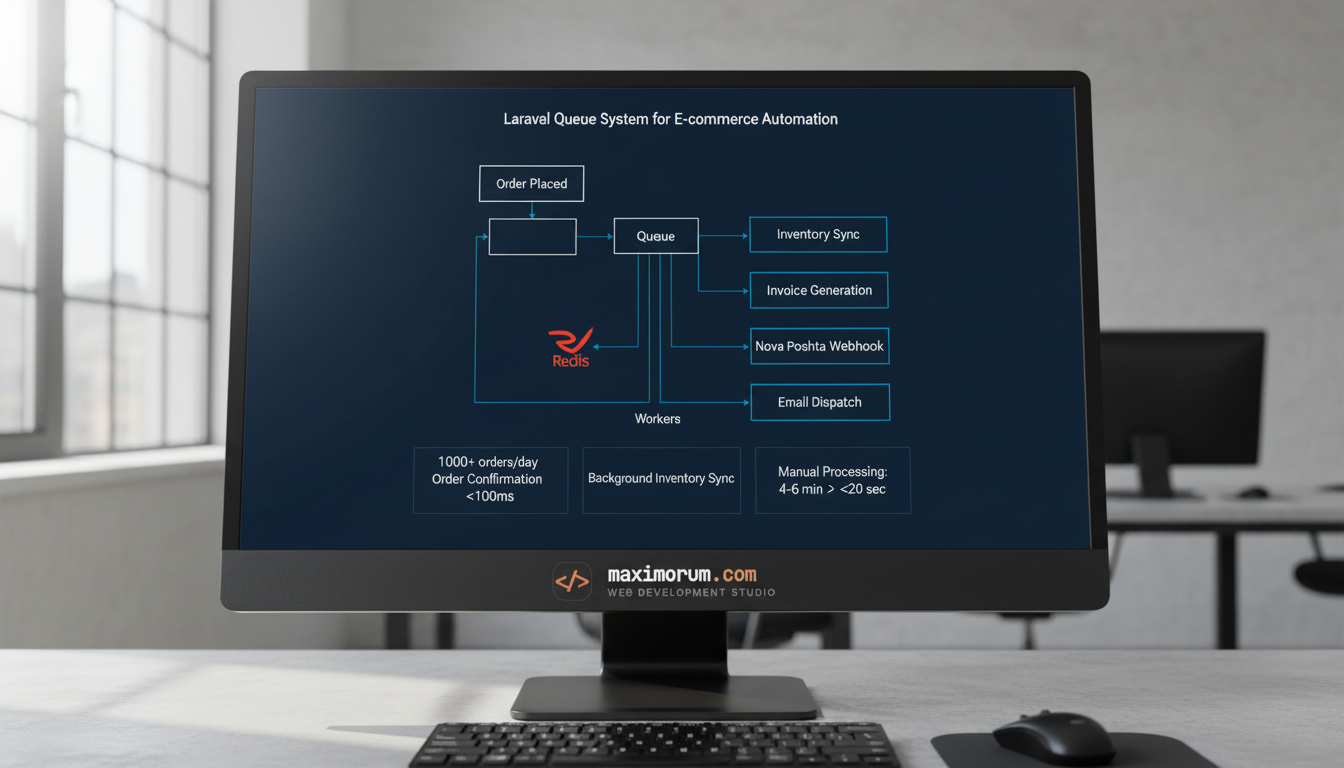
Running an online store means processing orders, sending confirmation emails, syncing inventory, generating invoices, and notifying warehouse staff — often simultaneously. When these operations run synchronously inside a single HTTP request, your customers wait. When they fail silently, your operations team scrambles.
Laravel's built-in queue system solves this cleanly. We configure jobs to run asynchronously — order confirmation emails dispatch in under 50 ms, inventory updates sync in the background, and failed jobs retry automatically with exponential backoff. The user sees a fast checkout; the business logic runs reliably behind the scenes.
How we implement it at MaxiMoruM
We wire Laravel Queues into every e-commerce project we build or migrate. A typical setup looks like this:
- Order placed →
ProcessOrderjob queued instantly; response returns to the user in under 100 ms - Background → inventory decremented, warehouse notified via webhook, invoice generated, confirmation email sent
- On failure → automatic retry (×3), then alert to the operations channel
We use Redis as the queue driver for performance, with Supervisor managing the queue workers on the server. For high-volume stores (1,000+ orders/day), we split queues by priority: critical jobs (payments, inventory) run on a dedicated worker, notifications on a lower-priority queue.
Business result
One client running OpenCart had manual order processing taking 4–6 minutes per order during peak load. After migrating their post-order workflow to Laravel Queues, average processing dropped to under 20 seconds — without additional staff.
When to use it
Queue-based processing makes sense whenever your application needs to:
- Send transactional emails or SMS at scale
- Sync data with third-party APIs (Nova Poshta, LiqPay callbacks, ERP systems)
- Generate PDF invoices or export reports
- Process uploaded files (images, imports)
If your PHP application still handles these tasks synchronously, you are leaving performance and reliability on the table. We migrate legacy codebases to queue-driven architecture as part of our standard modernisation service — without rewriting the entire application.