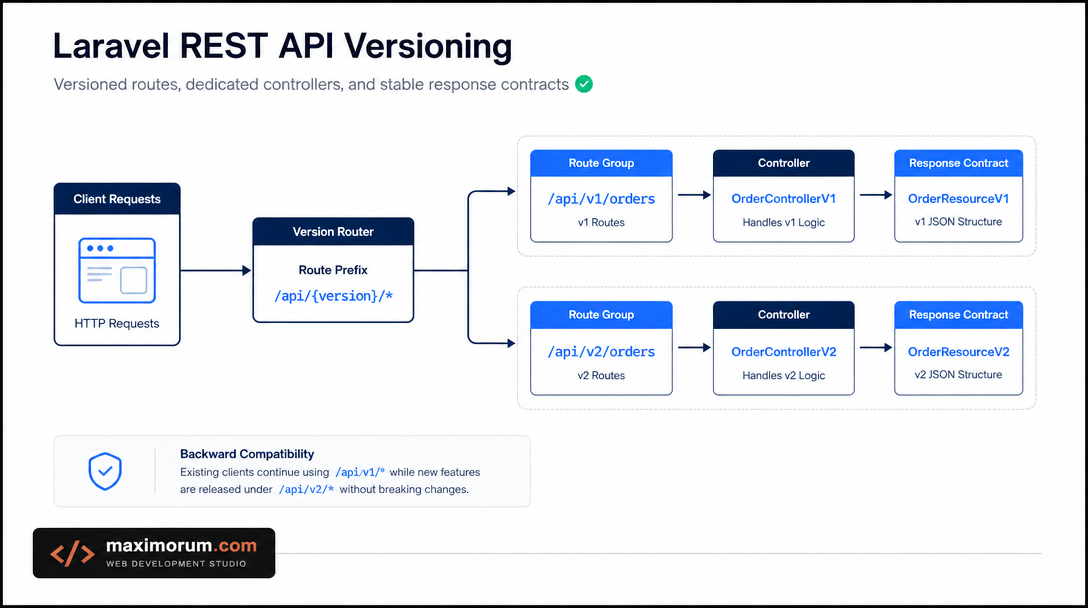
A client ships a mobile app, a React storefront, and a partner integration — all talking to one Laravel API. Six months in, the team renames a field from full_name to name and drops a column nobody seems to use. The web app updates fine. Then support fills up: the iOS app shows blank order screens, and a B2B partner's nightly sync fails silently. One "small" change broke three consumers at once, because they all depended on the exact shape of the response.
This is what API versioning and response contracts prevent. The API is a promise about the data you return. When that promise has no version and no boundary, every backend edit becomes a production risk.
Version at the route, not in the controller
Start with the URL. Group every public endpoint under an explicit version prefix so clients pin themselves to a known contract:
Route::prefix('v1')holds the current stable endpoints.Route::prefix('v2')introduces the breaking change — a renamed field, a new pagination format, a removed attribute.- Old clients stay on v1 and keep working. New clients adopt v2 on their own schedule.
Each version gets its own controller namespace (App\Http\Controllers\Api\V1, ...\V2). Duplicating a thin controller is far cheaper than an if ($version === 2) branch that grows tangled inside shared code.
Make the response a contract, not a raw model
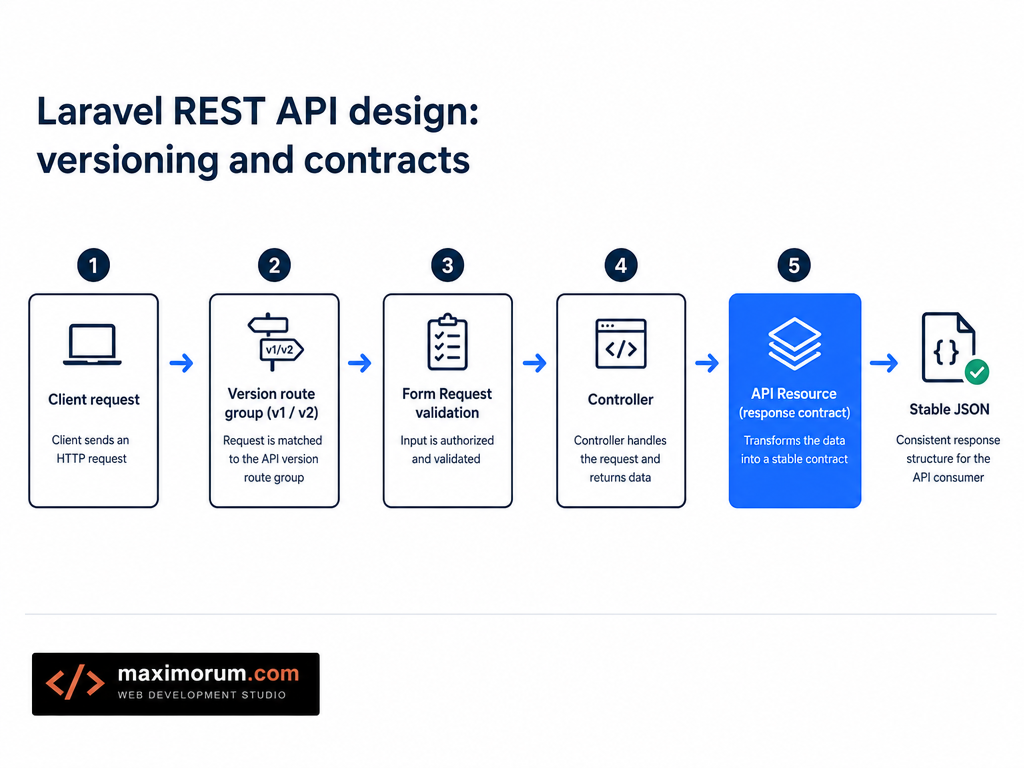
The second half of the problem is what you return. Handing back an Eloquent model with toJson() leaks your database schema to the world — every column, every rename, every accidental addition ships straight to clients. An API Resource fixes this by declaring the exact output shape:
- The Resource is the single source of truth for the JSON a version emits.
- You can rename or drop a database column without touching v1's response, because the Resource maps fields explicitly.
- Form Request classes validate input the same way — a fixed contract on the way in.
Below is how a single request moves through a versioned Laravel API — route group, validation, controller, and the Resource that guarantees a stable response:
How to evolve without breaking anyone
The workflow is disciplined and repeatable:
- Ship a change inside v1 only if it is additive — a new optional field never breaks an existing client.
- The moment a change is breaking — a rename, a removal, a restructured payload — it belongs in v2.
- Announce a deprecation window for v1 with a real end date, and monitor traffic per version so you retire the old one only when usage drops to zero.
The business result is measurable. Instead of a fire drill every time the schema evolves, the team ships changes on a predictable cadence. Partner integrations stop failing without warning. Mobile releases decouple from backend releases, so neither team blocks the other. The hours you would have lost to emergency hotfixes and apologetic support tickets go back into building features.
At MaxiMoruM we design Laravel APIs this way from day one — versioned routes, explicit Resources, validated requests — so your integrations survive growth instead of fighting it. If your API has become risky to change, let's talk: https://maximorum.com/