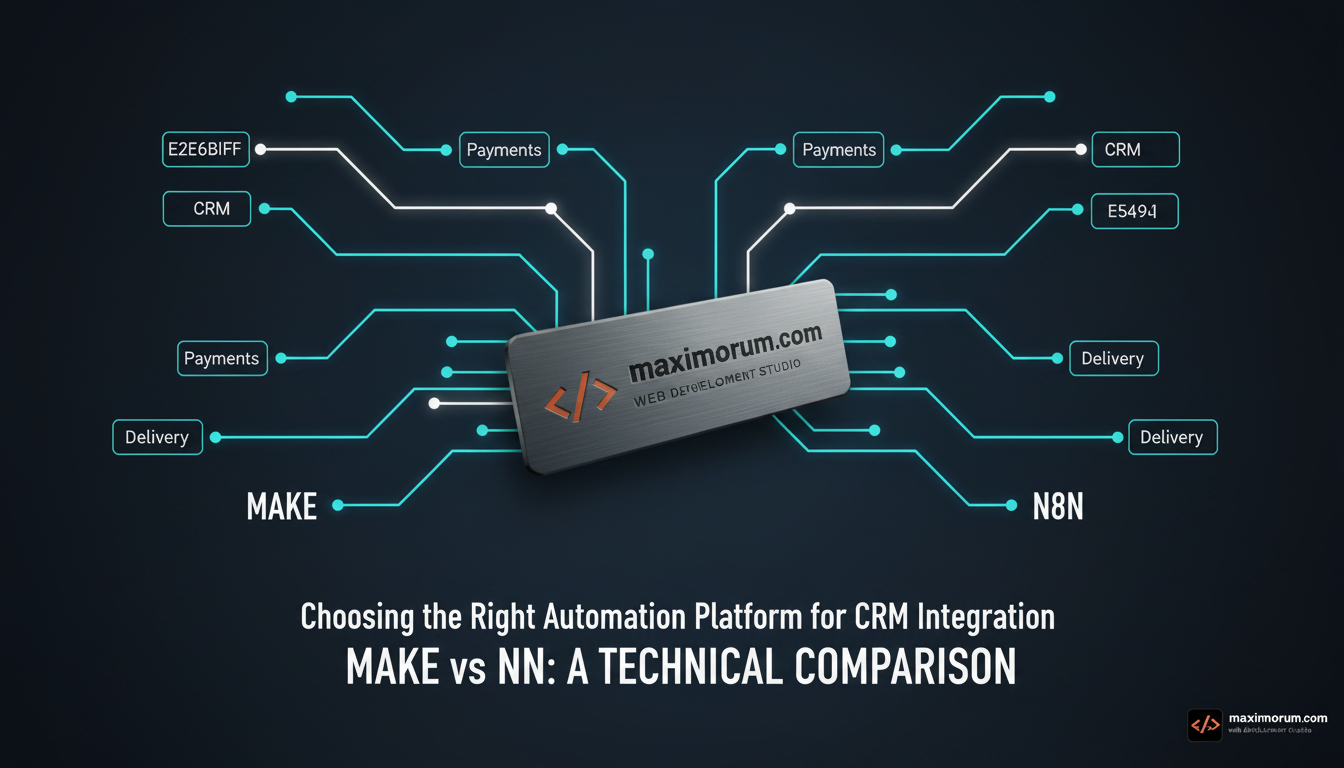
Make vs n8n: which automation platform fits your CRM integration
When your CRM stops talking to the rest of your stack, the cost shows up everywhere: sales reps re-key orders by hand, finance reconciles payments in spreadsheets, and managers chase delivery statuses across three tabs. Integration is no longer optional — the question is which engine to build it on. For most of our clients the real choice comes down to two platforms: Make (formerly Integromat) and n8n.
The business problem
A CRM that lives in isolation leaks money in small, constant ways. A new lead from your website form sits unassigned for an hour. A paid LiqPay or Monobank invoice doesn't flag the deal as "won" until someone checks the bank. A shipped order in OpenCart never writes its Nova Poshta tracking number back to the customer record. None of these is a disaster on its own — together they cost hours of manual work every week and erode trust in your data.
Automation closes those gaps by moving records between systems automatically, on every event, with no human in the loop. Both Make and n8n do this well. They differ in where they put the control.
Make: fast to ship, hosted for you
Make is a cloud-hosted visual builder. You connect your CRM, payment provider, and delivery service through ready-made modules, draw the scenario, and it runs on Make's infrastructure. There is nothing to host and nothing to patch. For a team that wants a lead-routing or payment-confirmation flow live this week, Make is the shortest path. The trade-off is operational: you pay per operation as volume grows, your data passes through a third-party cloud, and you are limited to the connectors Make ships.
n8n: self-hosted control and lower cost at scale
n8n is open-source and can run on your own server. You own the data, you set the execution limits, and a high-volume workflow costs you server capacity rather than a rising per-operation bill. n8n's HTTP and Function nodes let you call any API — including a custom Laravel endpoint or a raw OpenCart query — so there is no "unsupported connector" wall. The trade-off is that you maintain the instance: updates, backups, and uptime are yours.
How to decide
We recommend a simple test. Choose Make when speed-to-launch matters more than per-operation cost, volume is modest, and your connectors are all standard SaaS. Choose n8n when data must stay on your infrastructure, monthly volume is high enough that per-operation pricing hurts, or your integration touches custom code that no off-the-shelf connector covers. In practice, many of our Ukrainian clients land on n8n for exactly the third reason — LiqPay, Monobank, and Nova Poshta flows almost always need a custom webhook or signature step.
A typical CRM integration workflow looks the same on either platform:
- Trigger — a new lead, paid invoice, or shipped order fires a webhook.
- Map & validate — the scenario normalises and checks the fields.
- Write — the record is created or updated in the CRM.
- Notify — a Telegram alert reaches the responsible manager.
The difference is who runs and pays for that engine.
Bottom line
Make wins on time-to-value; n8n wins on cost-at-scale and control. There is no universal answer — only the one that fits your volume, your data-residency needs, and your stack. We build production integrations on both and recommend the platform your numbers actually justify.
Need a CRM that finally talks to your payments, delivery, and internal tools? Let's map your workflow: https://maximorum.com/