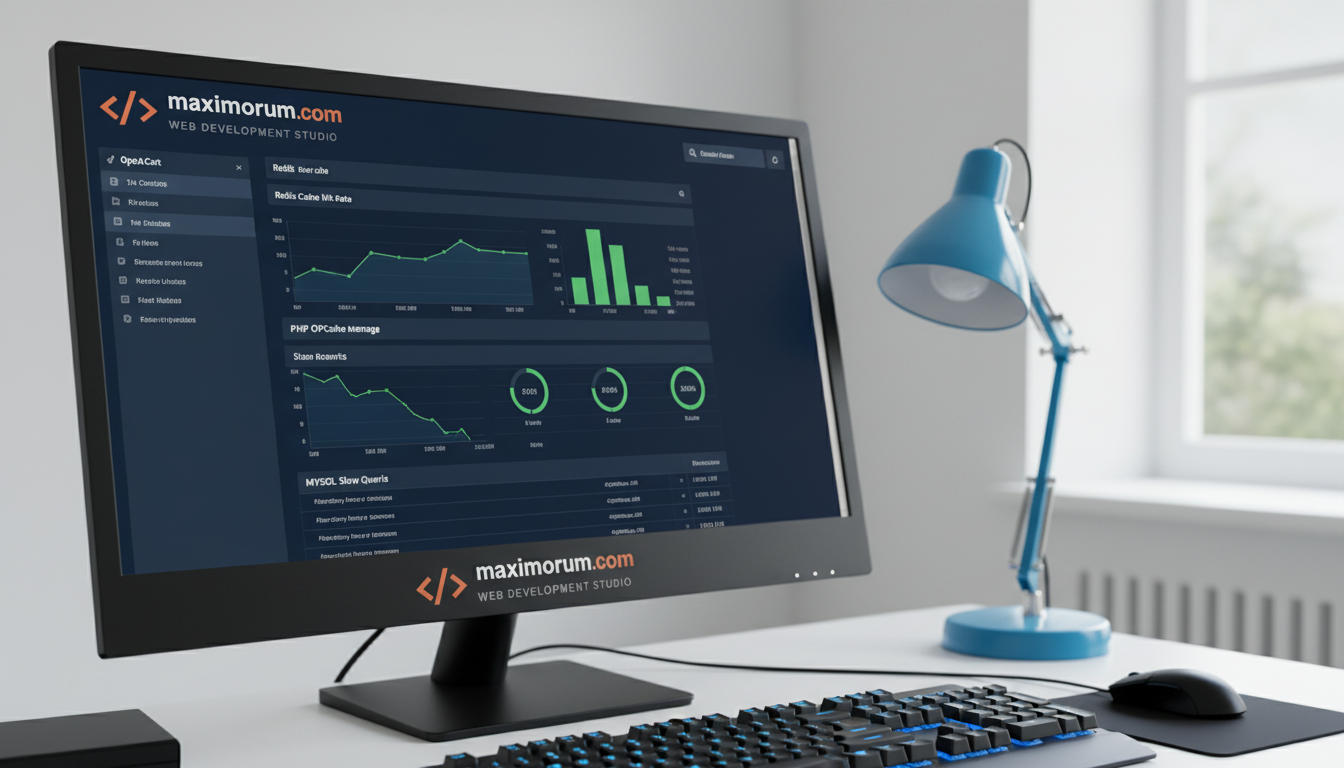
A one-second delay in page load time costs the average e-commerce store up to 7% in conversions. For OpenCart-powered businesses, the fix is systematic — not magical. Here is the engineering checklist MaxiMoruM applies to get load times under two seconds on production stores.
Audit and index your database
OpenCart runs on MySQL. Most live stores use default configurations tuned for development environments, not production traffic. Enable the slow query log, identify N+1 patterns on category and product pages, and add composite indexes on product_to_category, product_description, and url_alias tables. A tuned my.cnf alone reduces page generation time by up to 40%.
Enable PHP OPcache and upgrade to PHP 8.2+
Make sure OPcache is active with sufficient allocated memory: opcache.memory_consumption=256, opcache.max_accelerated_files=20000. On PHP 8.2 and above, JIT compilation adds another 10–15% on compute-intensive pages like search results and filtered category views.
Replace the file cache with Redis
OpenCart ships with a file-based cache driver. Replace it with Redis and configure a dedicated instance with an LRU eviction policy. Cache product descriptions, category trees, and layout data — these change rarely but are queried on every page load. On a mid-size catalog of 10,000+ SKUs, this change alone reduces database load by 60–80%.
Audit your installed extensions
Every active OpenCart module adds overhead to every HTTP request — including modules you no longer use. Audit your extensions list. Disable or uninstall anything not serving an active business function. Common offenders: abandoned SEO modules, redundant payment gateways, and analytics scripts that fire synchronously on page load.
Serve static assets from a CDN
Move product images, CSS, and JavaScript to a CDN. OpenCart generates image thumbnails on demand — pre-generate them via CLI and configure proper Cache-Control headers. Page weight drops by 30–50% for returning visitors, and server load decreases proportionally.
Measure, then act
Run a baseline measurement with Google PageSpeed Insights and GTmetrix before making any change. After each optimization, measure again. Document what moved the needle and by how much. Performance work without measurement is guesswork.
MaxiMoruM engineers OpenCart stores for performance — from server configuration up to the storefront. If your store is slow, we find the bottleneck and fix it. Get a technical audit at maximorum.com.