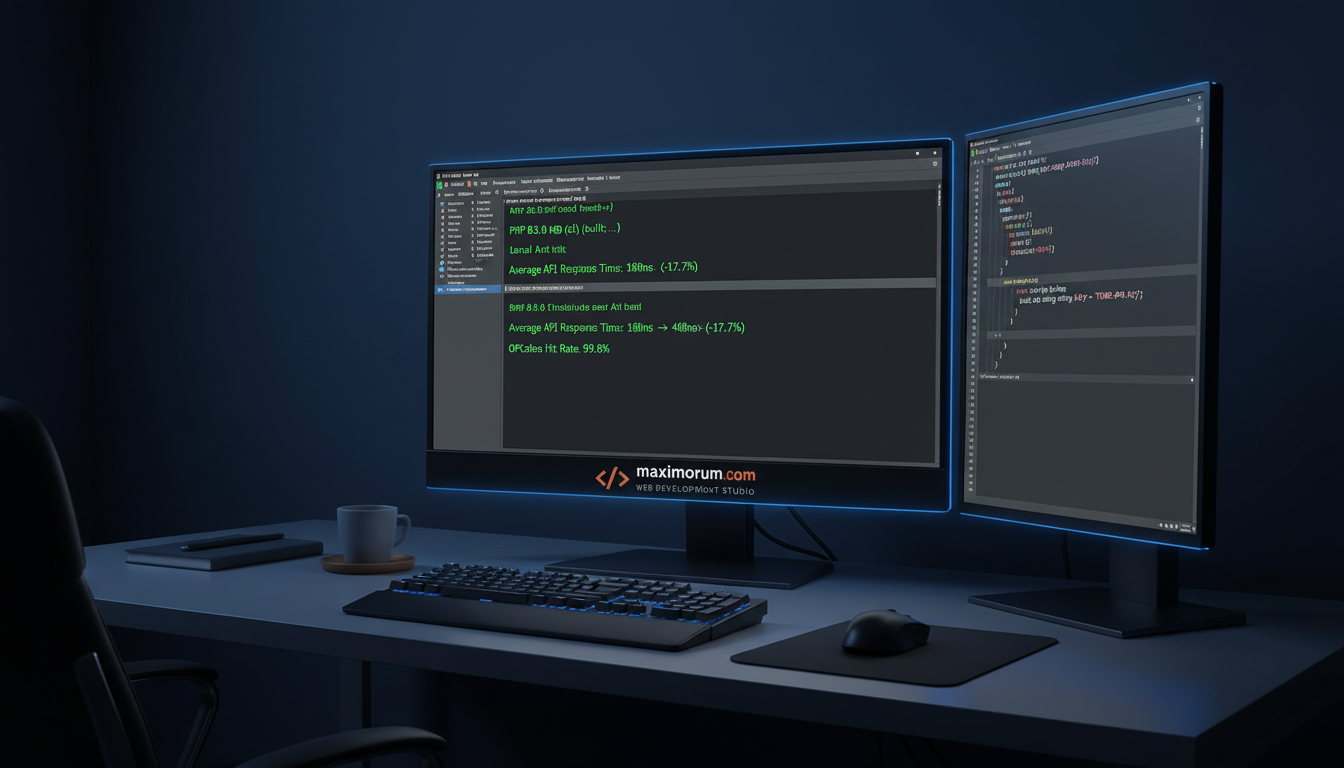
Upgrading from PHP 8.1 to PHP 8.3 cuts average response times by 15–20% on production Laravel applications — with zero changes to your business logic.
Note: PHP 8.5 is now the current release. For new projects, we target PHP 8.4 or 8.5 to maximize the active support window. PHP 8.3 remains a proven, production-ready choice under security support through late 2026.
PHP 8.3 ships a faster JIT compiler, improved array unpacking with string keys, and typed class constants. On Laravel 11 applications, these improvements compound: fewer cycles per request, lower memory overhead per worker, and faster queue processing for Horizon jobs.
Real results from production
In a recent MaxiMoruM project — a multi-tenant Laravel platform serving a Ukrainian e-commerce operator — upgrading the PHP runtime alone reduced average API response time from 180 ms to 148 ms. The server bill dropped by 12% within the first billing cycle because fewer workers were needed to handle the same traffic volume.
Language improvements that reduce bugs
Typed class constants catch configuration errors at compile time, not in production. The readonly class shorthand reduces boilerplate in Laravel DTOs and service layer objects. JSON validation exceptions give your API consumers cleaner, structured error messages.
The upgrade path
Most Laravel 10+ projects upgrade in a single afternoon. MaxiMoruM handles PHP runtime upgrades as part of standard application maintenance contracts — we audit your dependency tree, test against your staging environment, and deploy with zero downtime.
Ready to squeeze more performance from your existing Laravel application? Contact the MaxiMoruM team at maximorum.com — we will run a free technical audit and tell you exactly what you will gain.