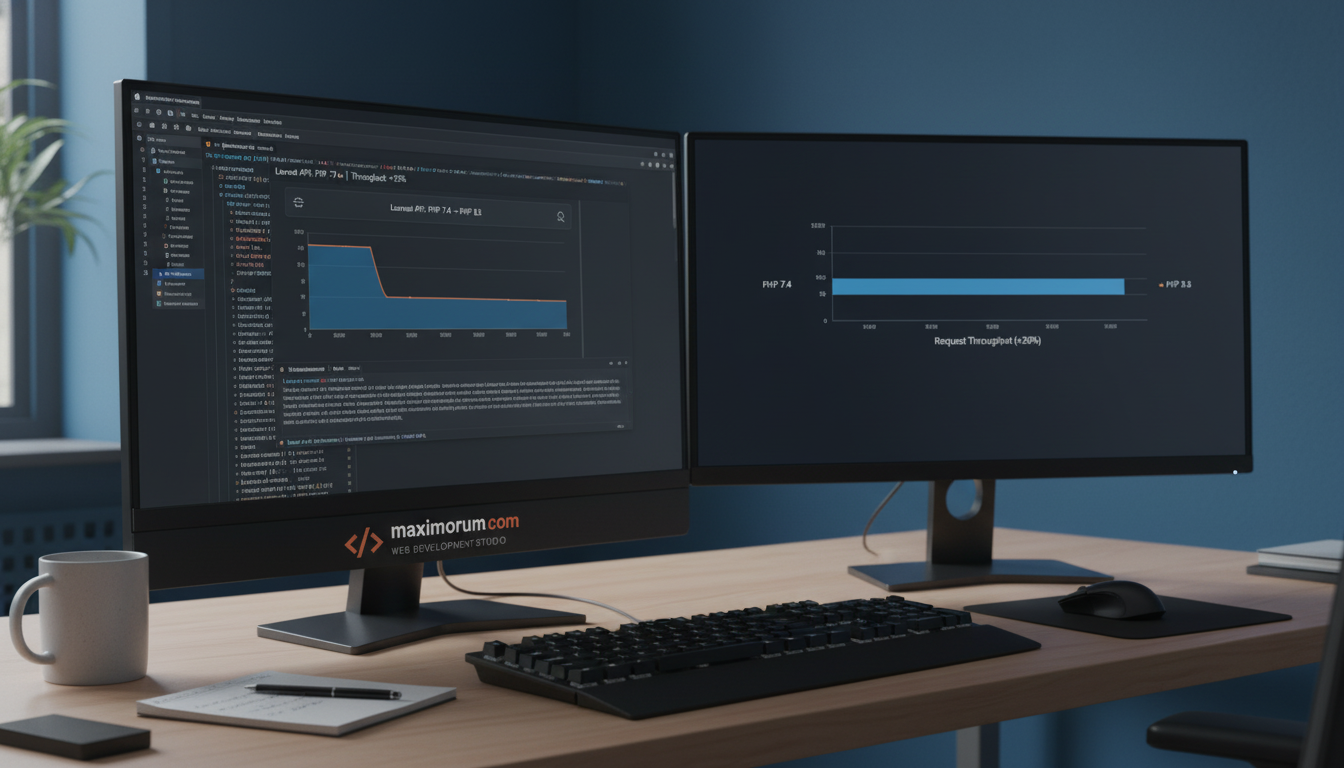
Upgrading PHP is not a maintenance task — it is a revenue decision. PHP 8.3 delivers measurable throughput improvements of 5–20% on typical Laravel API endpoints. Faster page loads, lower server costs, and higher conversion rates follow directly.
Note: PHP 8.5 is now the current release. PHP 8.3 remains under security support through late 2026. For new projects, we target PHP 8.4 or 8.5.
What changes at the engine level
PHP 8.3 introduces typed class constants, a granular json_validate() function, and deep-cloning of readonly properties. More importantly, it extends the JIT compiler improvements introduced in PHP 8.0, reducing CPU cycles per request on compute-heavy workloads.
For a Laravel 11 application handling 300 concurrent checkout requests, cutting average response time from 210 ms to 170 ms translates directly to fewer abandoned carts and lower infrastructure spend.
Impact on WordPress
WordPress 6.5+ ships with full PHP 8.3 compatibility. Sites running WooCommerce see measurable gains on product catalog pages and cart operations — pages that drive conversion directly. OPcache improvements in PHP 8.3 accelerate repeated execution cycles, which is exactly what a page-builder-heavy WordPress site needs.
What to check before upgrading
- Audit deprecated function calls — edge-case behavior changed in
array_is_list()andmb_str_split(). - Test your plugin stack (WooCommerce, WPML, caching plugins) against PHP 8.3 on a staging environment.
- Update
composer.jsonto"php": "^8.3"and runcomposer updateto catch incompatible dependencies. - Validate OPcache settings —
opcache.jit=tracingandopcache.jit_buffer_size=128Mare the production-recommended values.
The upgrade path at MaxiMoruM
We migrate WordPress and Laravel applications to current PHP versions as part of planned maintenance cycles. A typical migration — audit, staging validation, production cutover, post-deployment monitoring — takes two to three days. Clients on shared hosting get a side-by-side PHP version switch; VPS and cloud clients receive a zero-downtime config update.
Skipping the upgrade is not neutral: every minor version past end-of-life loses security patches. Falling two versions behind means unpatched vulnerabilities running in production — a risk no live e-commerce platform can afford.
Ready to upgrade?
Contact MaxiMoruM at maximorum.com — we audit your current stack and plan a zero-downtime migration to the current PHP release.