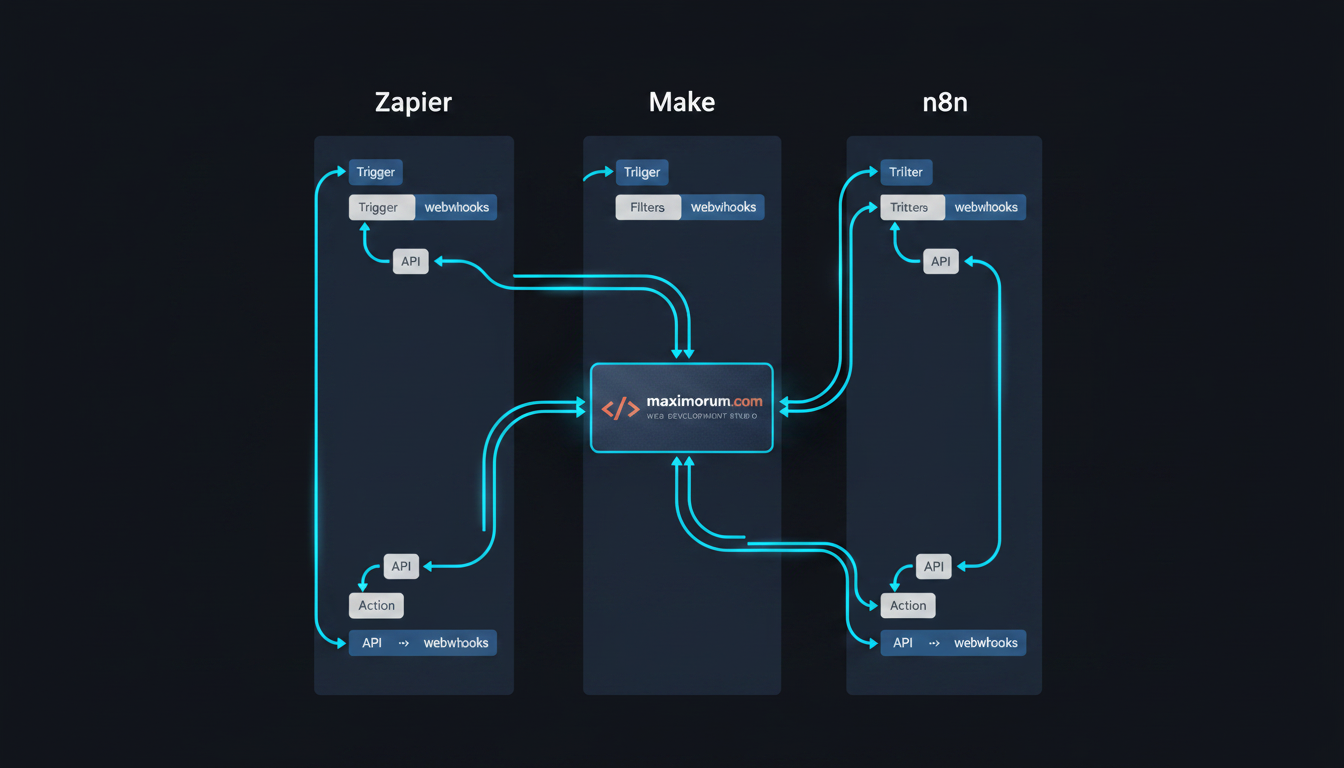
Every growing business reaches the same point: staff spend hours copying data between a CRM, an online store, a payment gateway, and a delivery service. Orders get re-typed, invoices are reconciled by hand, and a single missed notification turns into a refund. The fix is workflow automation — but the platform you pick decides how much you pay, how much control you keep, and how far the system scales. Zapier, Make, and n8n solve the same problem in very different ways.
The business problem
Manual data entry between systems is slow, error-prone, and impossible to audit. As order volume grows, the cost of one operator moving data climbs faster than revenue. Automation removes that overhead — but only if the tool matches your transaction volume, your integration needs, and your budget. The most common mistake we see is teams starting on a per-task plan that quietly becomes the largest line item in their software budget.
Zapier: fastest to launch, priced per task
Zapier is the quickest way to connect popular SaaS apps with no technical setup. It is a strong fit for small teams automating a handful of simple flows — a form submission into a spreadsheet, a new lead into a CRM. The trade-off is cost: Zapier bills per task, so high-volume e-commerce operations (thousands of orders a month) hit steep pricing tiers fast. It also offers limited control over complex branching logic and custom API calls.
Make: visual depth at a lower cost
Make (formerly Integromat) gives you a visual builder with far more control over data structures, iterators, and error handling, usually at a lower price per operation than Zapier. It handles multi-step scenarios — split an order, format the payload, call two APIs, then log the result — without writing code. For mid-sized businesses with moderately complex flows and a tight budget, Make is often the sweet spot.
n8n: full control and self-hosting
n8n is open-source and can be self-hosted on your own server, which changes the economics entirely. Instead of paying per task, you pay for the infrastructure — predictable cost regardless of volume. n8n keeps sensitive data (payment records, customer details) inside your environment, supports custom JavaScript nodes, and integrates cleanly with Ukrainian services such as LiqPay, Monobank, and Nova Poshta through native HTTP and webhook nodes. For high-volume stores and businesses with compliance requirements, n8n delivers the best long-term ROI.
A practical example
Consider an OpenCart store processing 3,000 orders a month with LiqPay payments and Nova Poshta delivery. A typical n8n workflow:
- A LiqPay webhook triggers the flow the moment a payment is confirmed.
- n8n writes the paid order to the database and updates its status.
- It calls the Nova Poshta API to create a shipment and retrieve a tracking number.
- A Laravel queue dispatches the customer email and a Telegram notification to the warehouse.
- A daily summary lands in Google Sheets for reconciliation.
On Zapier, that volume and branching would be costly and constrained. On self-hosted n8n, it runs for the price of a small server.
How to choose
Pick Zapier for a few simple flows and a fast start. Pick Make for complex visual logic on a budget. Pick n8n when you need high volume, data ownership, and custom integrations with PHP, Laravel, WordPress, or OpenCart backends.
Build it right the first time
MaxiMoruM has spent 20+ years engineering web platforms and integrations. We design the automation architecture that fits your transaction volume and connect it to your Ukrainian payment and delivery stack — so your team stops re-typing data and your systems stay reliable. Talk to MaxiMoruM about automating your workflows.