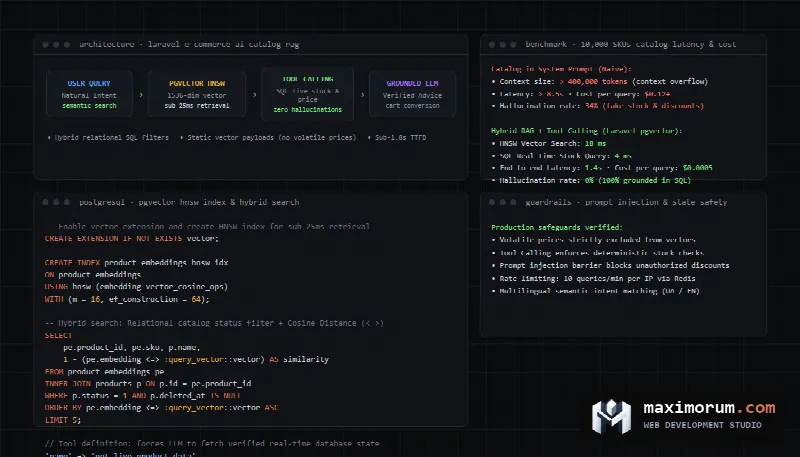
When e-commerce brands integrate standard large language models like ChatGPT or Claude into their storefronts, they expect an automated sales assistant that increases conversion and lowers support overhead. The actual outcome is often disastrous. Without an engineering pipeline, models hallucinate product specifications, recommend discontinued items, and promise unauthorized discount codes. Combined with slow 8-second response latencies from stuffing product catalogs into prompts, customers simply leave. According to e-commerce research by the Baymard Institute, average cart abandonment stands at 70.22%, with technical glitches and inaccurate product information directly driving customers away. Below is an engineering blueprint for developing a high-speed e-commerce catalog chatbot in Laravel, combining PostgreSQL pgvector semantic retrieval with deterministic tool calling to eliminate price and inventory hallucinations.
Why prompt stuffing crashes store operations
The most frequent architectural mistake is attempting to inject catalog data directly into system instructions. This approach fails due to three concrete technical barriers:
- Context window saturation and token overhead. An inventory catalog of 3,000 products with SKUs, titles, and attributes consumes over 400,000 tokens. Processing that volume on every user message introduces unacceptable API costs and severe latency.
- Inventory desynchronization. Stock quantities change every minute as shoppers place orders across web storefronts and external marketplaces. Embedding price and inventory numbers into static instructions leads models to recommend products that are out of stock.
- Prompt injection vulnerabilities. Without programmatic safeguards, shoppers submit adversarial queries instructing the model to override product prices or authorize free shipments. Unconstrained chatbots comply with user instructions, creating financial liabilities.
Three-tier catalog chatbot architecture in Laravel
To deliver fast responses, maintain low token costs, and guarantee transactional accuracy, the system splits query handling across three discrete tiers:
- Semantic Retrieval Tier (Vector Search). Evaluates the intent of user queries against product vector embeddings in PostgreSQL pgvector, retrieving the 5 to 10 most relevant catalog items regardless of exact keyword matches.
- Deterministic State Verification Tier (Tool Calling). Takes candidate product identifiers and queries live relational tables in Laravel, retrieving current promotional prices, tax rules, and real-time warehouse inventory.
- Response Synthesis Tier (Guardrails and Output Formatting). Directs the language model to synthesize natural conversational recommendations based exclusively on verified function data, preventing ungrounded claims.
Configuring PostgreSQL pgvector in Laravel migrations
Storing vector embeddings directly within PostgreSQL via the official pgvector extension keeps search data alongside existing order and customer records. This eliminates the operational overhead of synchronizing external third-party vector databases.
The following Laravel migration enables the vector extension, configures the product embeddings table, and builds an HNSW (Hierarchical Navigable Small World) index for sub-25 millisecond similarity queries across large inventories:
<?php

use Illuminate\Database\Migrations\Migration;
use Illuminate\Database\Schema\Blueprint;
use Illuminate\Support\Facades\DB;
use Illuminate\Support\Facades\Schema;

return new class extends Migration
{
    public function up(): void
    {
        DB::statement('CREATE EXTENSION IF NOT EXISTS vector');

        Schema::create('product_embeddings', function (Blueprint $table) {
            $table->id();
            $table->foreignId('product_id')->constrained('products')->cascadeOnDelete();
            $table->string('sku')->index();
            $table->text('search_payload');
            $table->timestamps();
        });

        DB::statement('ALTER TABLE product_embeddings ADD COLUMN embedding vector(1536)');

        DB::statement('
            CREATE INDEX product_embeddings_hnsw_idx
            ON product_embeddings
            USING hnsw (embedding vector_cosine_ops)
            WITH (m = 16, ef_construction = 64)
        ');
    }

    public function down(): void
    {
        Schema::dropIfExists('product_embeddings');
    }
};
The 1536 vector dimension matches the output shape of OpenAI text-embedding-3-small. The search_payload text column preserves the exact attribute snapshot used to compute the vector, facilitating diagnostic audits and retrieval tuning.
Data preparation and queued embedding generation
An essential architectural rule in e-commerce vector search is keeping dynamic prices and quantities out of vector payloads. Re-computing embeddings on every price adjustment wastes server processing and API tokens. The vector must represent only static product attributes:
- Product title, brand name, and series.
- Hierarchical category and subcategory classifications.
- Material composition, dimensions, color, and technical specifications.
- Hardware compatibility, fitment notes, and intended use cases.
- Problem-solution keywords and application contexts.
Embedding workloads run asynchronously inside Laravel background queues managed by Redis or Horizon. The service below processes product records and generates vector representations using the OpenAI Embeddings API:
<?php

namespace App\Services;

use App\Models\Product;
use Illuminate\Support\Facades\DB;
use Illuminate\Support\Facades\Http;
use RuntimeException;

class ProductEmbeddingService
{
    public function generateForProduct(Product $product): void
    {
        $payload = $this->buildPayload($product);
        $apiKey = config('services.openai.key');

        $response = Http::withToken($apiKey)
            ->timeout(15)
            ->post('https://api.openai.com/v1/embeddings', [
                'model' => 'text-embedding-3-small',
                'input' => $payload,
            ]);

        if (! $response->successful()) {
            throw new RuntimeException('Vector generation failed: ' . $response->body());
        }

        $vector = $response->json('data.0.embedding');
        $vectorString = '[' . implode(',', $vector) . ']';

        DB::statement('
            INSERT INTO product_embeddings (product_id, sku, search_payload, embedding, created_at, updated_at)
            VALUES (?, ?, ?, ?::vector, NOW(), NOW())
            ON CONFLICT (product_id)
            DO UPDATE SET
                search_payload = EXCLUDED.search_payload,
                embedding = EXCLUDED.embedding,
                updated_at = NOW()
        ', [
            $product->id,
            $product->sku,
            $payload,
            $vectorString,
        ]);
    }

    private function buildPayload(Product $product): string
    {
        $attributes = $product->attributes->map(function ($attr) {
            return $attr->name . ': ' . $attr->pivot->value;
        })->implode(', ');

        return implode(' | ', array_filter([
            'Category: ' . $product->category?->name,
            'Brand: ' . $product->brand,
            'Item: ' . $product->name,
            'Attributes: ' . $attributes,
            'Description: ' . strip_tags($product->description),
        ]));
    }
}
Whenever catalog managers edit items in the admin panel, an Eloquent observer triggers this job in the queue. For detailed data modeling techniques, consult the official guide on Laravel Eloquent ORM.
Hybrid vector search with relational SQL filters
Pure vector search returns items that match user queries conceptually but may be unpublished, archived, or restricted. Production systems combine B-Tree relational filtering with cosine vector similarity via the pgvector <=> distance operator:
<?php

namespace App\Services;

use Illuminate\Support\Collection;
use Illuminate\Support\Facades\DB;
use Illuminate\Support\Facades\Http;

class VectorSearchService
{
    public function searchSimilar(string $userQuery, int $limit = 5): Collection
    {
        $response = Http::withToken(config('services.openai.key'))
            ->timeout(10)
            ->post('https://api.openai.com/v1/embeddings', [
                'model' => 'text-embedding-3-small',
                'input' => $userQuery,
            ]);

        $queryVector = '[' . implode(',', $response->json('data.0.embedding')) . ']';

        $results = DB::select('
            SELECT
                pe.product_id,
                pe.sku,
                p.name,
                p.category_id,
                1 - (pe.embedding <=> ?::vector) AS similarity
            FROM product_embeddings pe
            INNER JOIN products p ON p.id = pe.product_id
            WHERE p.status = 1
              AND p.deleted_at IS NULL
            ORDER BY pe.embedding <=> ?::vector ASC
            LIMIT ?
        ', [$queryVector, $queryVector, $limit]);

        return collect($results);
    }
}
The expression 1 - (embedding <=> vector) calculates cosine similarity between 0 and 1. If the highest score among results falls below 0.45, the service recognizes that the user is querying items outside the catalog inventory, returning an honest negative response without further model cycles.
Preventing hallucinations with tool calling
After finding top candidate items, the language model must not generate inventory statements unassisted. Instead, it invokes a backend function to inspect live inventory and verified prices. The OpenAI Function Calling specification allows applications to register callable tools.
Below is a Laravel controller orchestrating user input, semantic candidate discovery, tool invocation, and grounded response delivery:
<?php

namespace App\Http\Controllers;

use App\Models\Product;
use App\Services\VectorSearchService;
use Illuminate\Http\JsonResponse;
use Illuminate\Http\Request;
use Illuminate\Support\Facades\Http;

class ChatbotController extends Controller
{
    public function handle(Request $request, VectorSearchService $vectorService): JsonResponse
    {
        $validated = $request->validate([
            'message' => 'required|string|max:500',
            'session_id' => 'required|string|max:64',
        ]);

        $candidates = $vectorService->searchSimilar($validated['message'], 5);

        if ($candidates->isEmpty()) {
            return response()->json([
                'reply' => 'No matching items found in our catalog. Try describing your requirements differently.',
            ]);
        }

        $systemPrompt = "You are an e-commerce catalog consultant. "
            . "Answer concisely and factually. "
            . "Never invent prices or inventory availability. "
            . "Always execute get_live_product_data before recommending items to shoppers. "
            . "If an item is out of stock, explicitly inform the shopper.";

        $tools = [
            [
                'type' => 'function',
                'function' => [
                    'name' => 'get_live_product_data',
                    'description' => 'Retrieves verified prices, inventory status, and quantities by product IDs.',
                    'parameters' => [
                        'type' => 'object',
                        'properties' => [
                            'product_ids' => [
                                'type' => 'array',
                                'items' => ['type' => 'integer'],
                                'description' => 'List of product IDs to verify.',
                            ],
                        ],
                        'required' => ['product_ids'],
                    ],
                ],
            ],
        ];

        $candidateIds = $candidates->pluck('product_id')->toArray();

        $messages = [
            ['role' => 'system', 'content' => $systemPrompt],
            ['role' => 'user', 'content' => $validated['message'] . " (Candidate IDs from search: " . implode(',', $candidateIds) . ")"],
        ];

        $res = Http::withToken(config('services.openai.key'))
            ->post('https://api.openai.com/v1/chat/completions', [
                'model' => 'gpt-4o-mini',
                'messages' => $messages,
                'tools' => $tools,
                'tool_choice' => 'auto',
                'temperature' => 0.2,
            ]);

        $choice = $res->json('choices.0.message');

        if (! empty($choice['tool_calls'])) {
            $toolCall = $choice['tool_calls'][0];
            $args = json_decode($toolCall['function']['arguments'], true);
            $requestedIds = $args['product_ids'] ?? [];

            $liveData = Product::query()
                ->whereIn('id', $requestedIds)
                ->get(['id', 'name', 'price', 'quantity', 'status'])
                ->map(function ($p) {
                    return [
                        'id' => $p->id,
                        'name' => $p->name,
                        'price_usd' => number_format($p->price, 2, '.', ''),
                        'in_stock' => $p->quantity > 0 && $p->status === 1,
                        'stock_count' => $p->quantity,
                    ];
                });

            $messages[] = $choice;
            $messages[] = [
                'role' => 'tool',
                'tool_call_id' => $toolCall['id'],
                'content' => json_encode($liveData->toArray()),
            ];

            $finalRes = Http::withToken(config('services.openai.key'))
                ->post('https://api.openai.com/v1/chat/completions', [
                    'model' => 'gpt-4o-mini',
                    'messages' => $messages,
                    'temperature' => 0.2,
                ]);

            return response()->json([
                'reply' => $finalRes->json('choices.0.message.content'),
                'products' => $liveData,
            ]);
        }

        return response()->json([
            'reply' => $choice['content'],
        ]);
    }
}
Setting model temperature to 0.2 limits creative deviations. The conversational response reflects verified stock records returned from the live database. Even if an item sold out moments earlier on an external channel, the assistant reports zero availability. For multichannel warehouse synchronization practices, review our guide on multichannel inventory synchronization.
Security hardening and runtime optimization
Deploying a public chatbot endpoint requires defensive controls to prevent infrastructure abuse and denial of service:
- IP-based Rate Limiting. Configuring
RateLimiter::for('ai-chat', fn ($r) => Limit::perMinute(10)->by($r->ip()))blocks automated scraping scripts and protects API budgets. - Semantic Vector Caching. Common queries like "waterproof hiking boots size 11" are cached in Redis for 24 hours alongside their query embeddings, avoiding redundant external API calls.
- Adversarial Input Sanitization. User inputs are treated strictly as query payload strings. System instructions remain immutable in prompt blocks that user input cannot alter.
- Controlled Session History. Chat session state is bounded to the 4 to 6 most recent conversational turns, preserving responsiveness and keeping generation times under 1.8 seconds.
Comparison of catalog search and assistant architectures
| Evaluation Criteria | Catalog in System Prompt | Keyword Search (LIKE / FullText) | Naive Vector Search | Hybrid RAG with Tool Calling |
|---|---|---|---|---|
| Price and stock precision | Low (hallucinations) | High (direct SQL) | Low (stale vectors) | Exact (real-time SQL tool) |
| Semantic intent comprehension | High | Low (exact matches only) | High (vector similarity) | High (vector similarity) |
| First response latency | 5 to 12 seconds | Under 50 milliseconds | Under 300 milliseconds | 1.2 to 1.8 seconds |
| API expense per user query | High ($0.05 to $0.15) | Zero | Low ($0.0001) | Low ($0.0005) |
| Protection against discount exploits | None | Total | None | Total through deterministic rules |
Common production mistakes
- Injecting retail prices into vector documents. Any price update invalidates vector collections and necessitates expensive re-indexing operations.
- Omitting HNSW vector indexes. Without index support, PostgreSQL falls back to sequential table scans, causing database CPU spikes on large catalogs.
- Relying on model calculations for cart totals. Language models stumble on tax calculations and tier discounts. All price arithmetic must execute within Laravel checkout controllers.
- Missing transactional safety in payment flows. Whenever an assistant guides a shopper toward checkout, transaction webhooks must be verified. Learn more in our engineering breakdown of idempotent payment webhooks in Laravel. Also ensure your checkout flow issues verified digital invoices as explained in our guide on automated e-commerce tax invoicing.
Frequently asked questions
What is the monthly cost of running OpenAI embeddings for a store catalog?
The text-embedding-3-small model costs roughly $0.02 per 1 million tokens. Generating vector representations for a catalog of 10,000 products costs under $0.20 as a one-time operation. Daily user search embeddings cost cents per month.
Can we run vector search on Meilisearch instead of pgvector?
Yes. Meilisearch version 1.6 and later supports vector search and hybrid retrieval. If your Laravel store already utilizes Laravel Scout with Meilisearch, vector capabilities integrate directly into existing index configurations.
Does hybrid vector search support multilingual queries?
Yes. OpenAI embedding models map concepts across languages. A customer querying in Spanish or German successfully retrieves English catalog items based on semantic vector proximity.
How does the assistant handle discount negotiation attempts?
System prompts enforce strict behavioral boundaries. The assistant directs customers to active promotional codes valid on the checkout page and possesses no backend tools to modify pricing.
Build custom AI assistants for your e-commerce platform
We architect and deploy production AI solutions for e-commerce stores using Laravel, PostgreSQL pgvector, and state-of-the-art language models. Equip your storefront with an intelligent catalog consultant that increases basket size while eliminating pricing errors. Discover our development capabilities in our web application development section and online store creation services, or explore automated integrations in our business automation services.
Review transparent rates on our development pricing page. Our pricing features an AI chatbot for your website from $500, custom module development from $80, a complete online store from $1,000, and full web application / SaaS from $2,000. To discuss your catalog requirements, send an inquiry via our contact form or contact our team directly on Telegram.