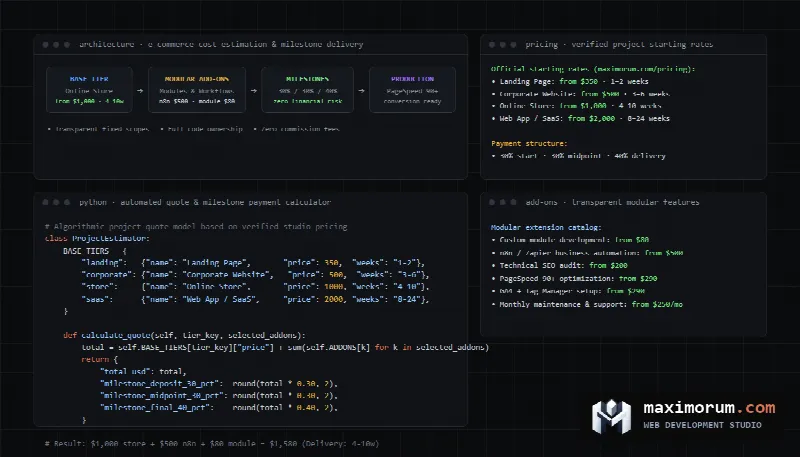
When merchants plan to launch or upgrade an e-commerce platform, their primary question centers on realistic development costs and delivery schedules. The market presents confusing price quotes. Some freelancers promise turnkey online stores for $200 within three days, while traditional agencies deliver proposals exceeding $15,000 across six months. Business owners rarely receive transparent explanations regarding what deliverables are included or what recurring technical debt will emerge post-launch. According to global research by the Baymard Institute, average digital shopping cart abandonment reaches 70.22%, with slow load times, broken layouts, and checkout errors directly causing customers to leave. Below is an engineering breakdown of project budget components, realistic development milestones, and how backend process automation eliminates manual operating costs.
The true risks of cheap website templates
Attempting to launch an e-commerce venture using $200 pre-built marketplace themes almost universally leads to financial loss. At that price point, developers do not engineer software; they simply import bloated themes packed with unmaintained scripts. This shortcuts introduce severe operational bottlenecks:
- Sluggish mobile page performance. Off-the-shelf themes load dozens of unnecessary CSS frameworks and tracking libraries. Mobile Google PageSpeed scores rarely surpass 35 out of 100 points. Every additional second of catalog latency degrades conversion by 7% to 10%.
- Critical security liabilities. Pirated or neglected plugins contain unpatched vulnerabilities, inviting brute-force intrusions, spam injection, and blacklisting by search engines.
- Scalability barriers. When product catalogs expand beyond 5,000 SKUs, unindexed database tables choke under query loads. Faceted filter queries take over 5 seconds, triggering 504 Gateway Timeout errors.
- Absence of business automation. Budget templates lack direct interfaces with banking gateways, courier services, or inventory databases. Store owners are forced to hire staff to transcribe orders manually.
Core pricing tiers across web projects
Professional web engineering costs reflect transparent labor estimates. In our development studio, starting rates are published across distinct project tiers:
- Landing Page. High-converting single-page site designed for rapid marketing campaigns. Pricing starts from $350 with a delivery timeframe of 1 to 2 weeks.
- Corporate Website. Multi-page presence on WordPress or custom Laravel backends for B2B brands and professional service providers. Pricing starts from $500 with a timeline of 3 to 6 weeks.
- Online Store. Full-featured e-commerce storefront on WooCommerce, OpenCart, or custom Laravel. Base pricing starts from $1,000 with delivery spanning 4 to 10 weeks.
- Web Application / SaaS. Scalable bespoke web platforms built with Laravel backends and Vue or React frontends. Pricing starts from $2,000 with a timeline of 8 to 24 weeks.
Deconstructing the e-commerce store estimate
The baseline $1,000 budget establishes an engineered foundation for commercial operations. It covers catalog architecture with faceted filtering, internal search indexing, standard payment gateway integration, shipping calculators, order management dashboards, mobile-responsive layouts, and performance optimization targeting PageSpeed 90+.
As business requirements expand, merchants incorporate modular enhancements. Store owners select strictly the add-ons required for their operational model:
- Custom module development. Tailored solutions for proprietary shipping algorithms, unique payment gateways, or custom discount tiers. Pricing starts from $80.
- Workflow automation with n8n or Zapier. Event-driven pipelines connecting web stores with fulfillment centers, accounting software, and instant messaging alerts. Setup starts from $500.
- CRM platform integration. Synchronizing customer pipelines with HubSpot, Pipedrive, or ERP systems. Implementation starts from $690.
- Multilingual expansion (i18n). Separate localized URL structures with bidirectional hreflang tags for cross-border commerce. Configuration starts from $590.
- GA4 and Google Tag Manager analytics. Server-side purchase attribution, checkout funnels, and revenue tracking. Setup starts from $290.
- PageSpeed 90+ optimization. Advanced performance tuning bringing mobile Core Web Vitals into green zones. Pricing starts from $290.
- Technical SEO audit. Crawl audits, canonical mapping, redirect verification, and structured data schemas. Services start from $200.
- AI catalog chatbot. Intelligent shopping assistants querying live databases without hallucinating prices. Integration starts from $500.
- Custom design in Figma. Senior UI and UX designers crafting bespoke layouts. Rates start from $1,000.
- Monthly maintenance and support. Plugin upgrades, security audits, database maintenance, and emergency response. Plans start from $250 per month.
Five development milestones across a 4 to 10 week schedule
Building a resilient e-commerce website follows five structured phases with verifiable client checkpoints:
- Architecture and database design (Weeks 1 to 2). Catalog taxonomy modeling, database schema specification, user journey wireframing, and checkout flow approval.
- Frontend engineering and catalog build (Weeks 3 to 5). Component layout development, responsive mobile styling, faceted search filters, and product detail templating.
- Payment and logistics integration (Weeks 6 to 7). Webhook endpoints for Stripe, monobank, or PayPal, shipping calculation APIs, and automated transactional emails.
- Process automation and compliance (Weeks 7 to 8). Automated tax invoicing, real-time inventory synchronization, and XML feed generators. For automated tax compliance methods, review our guide on automated e-commerce tax invoicing. For multichannel warehouse sync practices, read our analysis on multichannel inventory synchronization.
- End-to-end testing and deployment (Weeks 9 to 10). Simulated transaction testing, PageSpeed audits, SSL installation, and production DNS cutover.
Transparent payment structure without financial risk
To eliminate financial risk for merchants, projects execute under a three-stage milestone payment model. Clients never pay full contract values upfront:
- 30% project deposit. Paid upon agreement signing to reserve engineering capacity and launch architectural blueprints.
- 30% midpoint milestone. Invoiced midway through the timeline after verifying functional catalog navigation, frontend components, and database structure on a private staging server.
- 40% final delivery payment. Invoiced strictly after complete acceptance testing, bug remediation, and administrative training.
For large enterprise builds and SaaS systems, billing converts to monthly milestone phases. Invoices are issued in USD, EUR, or UAH via bank wire transfer or credit card processing.
Automating project estimations via code
The Python script below models quote calculations based on modular selections, automatically outputting milestone payment schedules and expected delivery intervals:
class ProjectEstimator:
    BASE_TIERS = {
        "landing": {"name": "Landing Page", "price": 350, "weeks": "1-2"},
        "corporate": {"name": "Corporate Website", "price": 500, "weeks": "3-6"},
        "store": {"name": "Online Store", "price": 1000, "weeks": "4-10"},
        "saas": {"name": "Web Application / SaaS", "price": 2000, "weeks": "8-24"},
    }

    ADDONS = {
        "custom_module": {"name": "Custom Module", "price": 80},
        "automation_n8n": {"name": "n8n Automation Flow", "price": 500},
        "crm_integration": {"name": "CRM Integration", "price": 690},
        "seo_audit": {"name": "Technical SEO Audit", "price": 200},
        "pagespeed_90": {"name": "PageSpeed 90+ Optimization", "price": 290},
        "ga4_setup": {"name": "GA4 + Tag Manager Setup", "price": 290},
        "extra_lang": {"name": "Extra Language (i18n)", "price": 590},
        "ai_chatbot": {"name": "AI Catalog Chatbot", "price": 500},
        "custom_figma": {"name": "Custom Figma Design", "price": 1000},
    }

    def calculate_quote(self, tier_key: str, selected_addons: list) -> dict:
        tier = self.BASE_TIERS.get(tier_key, self.BASE_TIERS["store"])
        base_price = tier["price"]
        addons_total = sum(self.ADDONS[k]["price"] for k in selected_addons if k in self.ADDONS)
        total = base_price + addons_total

        return {
            "tier_name": tier["name"],
            "timeline_weeks": tier["weeks"],
            "total_estimate_usd": total,
            "payment_schedule": {
                "step_1_deposit_30_pct": round(total * 0.30, 2),
                "step_2_midpoint_30_pct": round(total * 0.30, 2),
                "step_3_final_40_pct": round(total * 0.40, 2),
            },
        }

estimator = ProjectEstimator()
quote = estimator.calculate_quote("store", ["custom_module", "automation_n8n", "ga4_setup"])
print(f"Total: ${quote['total_estimate_usd']} (Timeline: {quote['timeline_weeks']} weeks)")
Transparent algorithmic estimation eliminates guesswork, allowing executives to forecast capital expenditure accurately before committing engineering resources.
Comparing modern e-commerce deployment models
Merchants evaluating technology platforms weigh ongoing SaaS subscriptions against owned digital assets. The comparison below outlines capital and operational tradeoffs:
| Evaluation Metric | Hosted SaaS (Shopify / BigCommerce) | Budget Template Build | Engineered OpenCart Store | Custom Laravel Architecture |
|---|---|---|---|---|
| Initial Investment | $100 to $500 initial setup | $200 to $400 | From $1,000 | From $2,000 |
| Recurring Platform Fees | $30 to $300 monthly + 1-2% revenue cut | Server hosting only | Hosting only (from $10/mo) | Scalable cloud hosting |
| Code Ownership | Zero (rented ecosystem) | Limited template rights | Full client ownership | Full client ownership |
| Automation Extensibility | Restricted by app store rules | Fragile (risk of breaking) | High (custom modules from $80) | Unlimited architectural freedom |
| Performance at 20,000+ SKUs | Managed by platform | Frequent database crashes | High via Redis caching | Enterprise grade with queues |
To orchestrate flexible backend operations without recurring per-seat SaaS costs, we implement self-hosted workflows using n8n workflow automation, linking inventory and payment records directly to your databases.
Common budgeting oversights in e-commerce projects
- Underestimating product data preparation. Generating photography, formatting attribute tables, and translating descriptions requires dedicated staff or automated supplier ingestion scripts.
- Investing in bespoke design prematurely. Startups validate unit economics faster by launching clean responsive components at $1,000, deferring $1,000 Figma design overhauls until transaction volumes justify it.
- Excluding marketing budgets from financial plans. The most elegant online storefront produces zero revenue without targeted customer acquisition via paid channels and organic search.
- Ignoring post-launch maintenance. Web platforms require ongoing security patching, backup testing, and framework updates to maintain uptime during seasonal sales spikes.
Frequently asked questions
Why does professional online store development start from $1,000?
The $1,000 price point represents the baseline engineering investment necessary to deliver clean database schemas, fast mobile layouts, secure checkout webhooks, and PageSpeed 90+ performance. Final budgets reflect exact brief requirements.
How can merchants reduce upfront launch expenses?
We structure projects in sequential releases. Phase one delivers a functional store with core catalog capabilities to launch sales quickly. Custom modules and integrations deploy in subsequent iterations funded by initial revenue.
Are server hosting and domain fees included in development quotes?
Domain registration and server hosting are billed directly by infrastructure providers to client accounts. Our engineering team assists with hosting selection and provides server configuration at no additional charge.
What warranty covers completed projects?
All delivered projects include warranty coverage to remediate any post-launch code defects. Clients can also engage ongoing monthly maintenance agreements for proactive updates.
Build an automated online store for your business
We engineer scalable digital commerce solutions using OpenCart, WooCommerce, and custom Laravel stacks. Equip your business with a high-speed online storefront featuring verified payment gateways and automated backend operations. Explore our service capabilities in our online store creation section and web application development services, or review automated integrations in our business automation services.
Review published rates on our development pricing page. Our options feature complete online stores from $1,000, landing pages from $350, corporate websites from $500, web applications from $2,000, custom module development from $80, and n8n workflow automation from $500. To receive an exact project quote and implementation schedule within 24 hours, submit an inquiry via our contact form or contact us directly on Telegram.